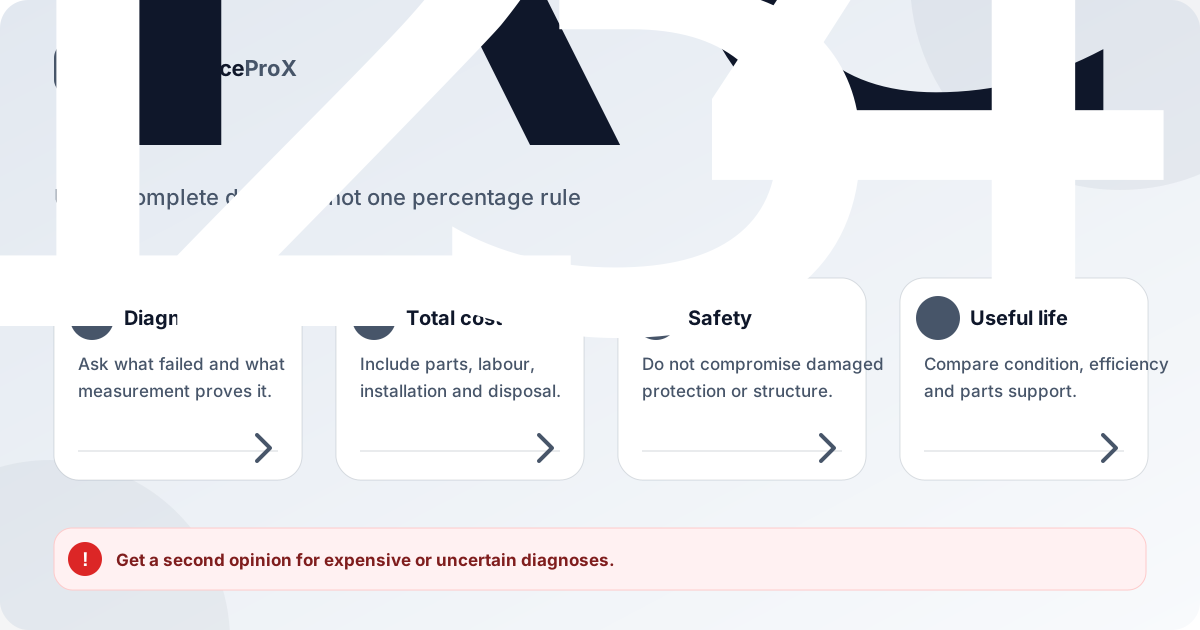
Repair or Replace a Home Appliance? A Cost and Safety Framework
The cheapest immediate option is not always the best long-term decision. A small repair can extend an appliance's life for years, while a major repair on a corroded or unsafe unit may only delay replacement. Rules such as “replace after half the new price” are too simple because installation cost, efficiency, warranty, parts availability and the quality of the diagnosis vary. A good decision starts with an itemised fault report and compares realistic total costs rather than an advertised appliance price alone.
Key takeaways
- Get a specific diagnosis and itemised estimate first.
- Safety and structural condition can outweigh cost percentages.
- Compare total ownership cost, including installation and disposal.
Start with the exact diagnosis
Ask which component failed, what measurements support the conclusion and whether another underlying issue caused it. “PCB problem” or “gas problem” without testing is not enough. The estimate should separate visit, labour, parts, consumables and tax, and should state whether the repair restores full function or only addresses one symptom.
For intermittent faults, provide videos, error codes and a timeline. A wrong diagnosis wastes money and can make replacement appear necessary. A second opinion is reasonable for an expensive compressor, sealed tub, control board or structural repair.
Consider age and remaining condition
Age matters, but condition matters more. An older appliance with a sound cabinet, available parts and one replaceable component may be worth repairing. A younger unit with severe corrosion, pest damage, repeated electrical faults or a cracked structural part may not be.
Review the service history. Several unrelated small repairs can indicate general wear, while the same recurring fault suggests the root cause was never corrected. Check whether doors, seals, bearings, wiring and controls remain healthy beyond the immediate complaint.
Compare full repair and replacement costs
A repair estimate should include likely labour and essential parts. A replacement budget should include delivery, installation, stands or plumbing changes, electrical upgrades, accessories, removal and any loss from changing capacity. The shop price alone is incomplete.
Estimate how long each option is likely to serve, acknowledging uncertainty. Divide total cost by expected years only as one guide. A repair with a written part and labour warranty has a different value from one with no support.
Make safety a non-negotiable factor
Damaged microwave doors, leaking water-heater tanks, burnt wiring, compromised insulation and severe cabinet corrosion can make continued use unsafe. A repair should restore the safety system, not bypass it. If safe restoration cannot be demonstrated, replacement is the better decision regardless of percentage formulas.
Check recalls and manufacturer notices for the exact model where relevant. Electrical protection, earthing, ventilation and plumbing must also be suitable. Replacing an appliance without correcting a bad socket, drain or installation can damage the new unit.
Evaluate efficiency without exaggerating savings
A new appliance may use less energy or water, but savings depend on household use and actual model performance. Compare official labels and measured consumption rather than marketing claims. An appliance used rarely may take many years to recover the environmental and financial cost of replacement.
A fault such as a damaged gasket or dirty coil can increase consumption and may be inexpensive to correct. On the other hand, an old refrigerator or AC that runs continuously despite sound maintenance may offer a stronger efficiency case for replacement.
Check parts, warranty and service support
Confirm whether the part is new, compatible, refurbished or recovered, and ask about warranty coverage. Very long headline warranties may apply only to one component and exclude labour. Read the actual terms before deciding.
Parts that are unavailable or require repeated adaptation increase future risk. A new model should also have local service support and standard consumables. Avoid buying solely because the discount is high if installation, filters or critical parts are difficult to obtain.
Dispose of the old appliance responsibly
Refrigerators and air conditioners contain refrigerant and oils that require responsible recovery. Electronic controls, motors and batteries also belong in appropriate recycling streams. Use authorised collection or take-back options available in your area.
Before disposal, remove personal data from smart appliances, cancel linked accounts and keep purchase and exchange records. Do not release refrigerant, burn wiring or leave a door-equipped appliance accessible to children.
Frequently asked questions
Is the 50 percent repair rule always correct?
No. Safety, condition, expected life, installation cost, warranty and parts availability can make a repair above or below that percentage sensible.
Should I repair a ten-year-old appliance?
Age alone is not decisive. A low-cost repair on a sound appliance may be reasonable, while a major structural or sealed-system repair needs closer comparison.
Does a new appliance always save money on electricity?
Not always. Savings depend on use, tariff, capacity and the difference in measured efficiency. Compare official ratings and realistic operating hours.
What should an itemised repair estimate include?
It should identify the diagnosed fault, parts, labour, consumables, visit charge, tax, expected completion and written warranty terms.